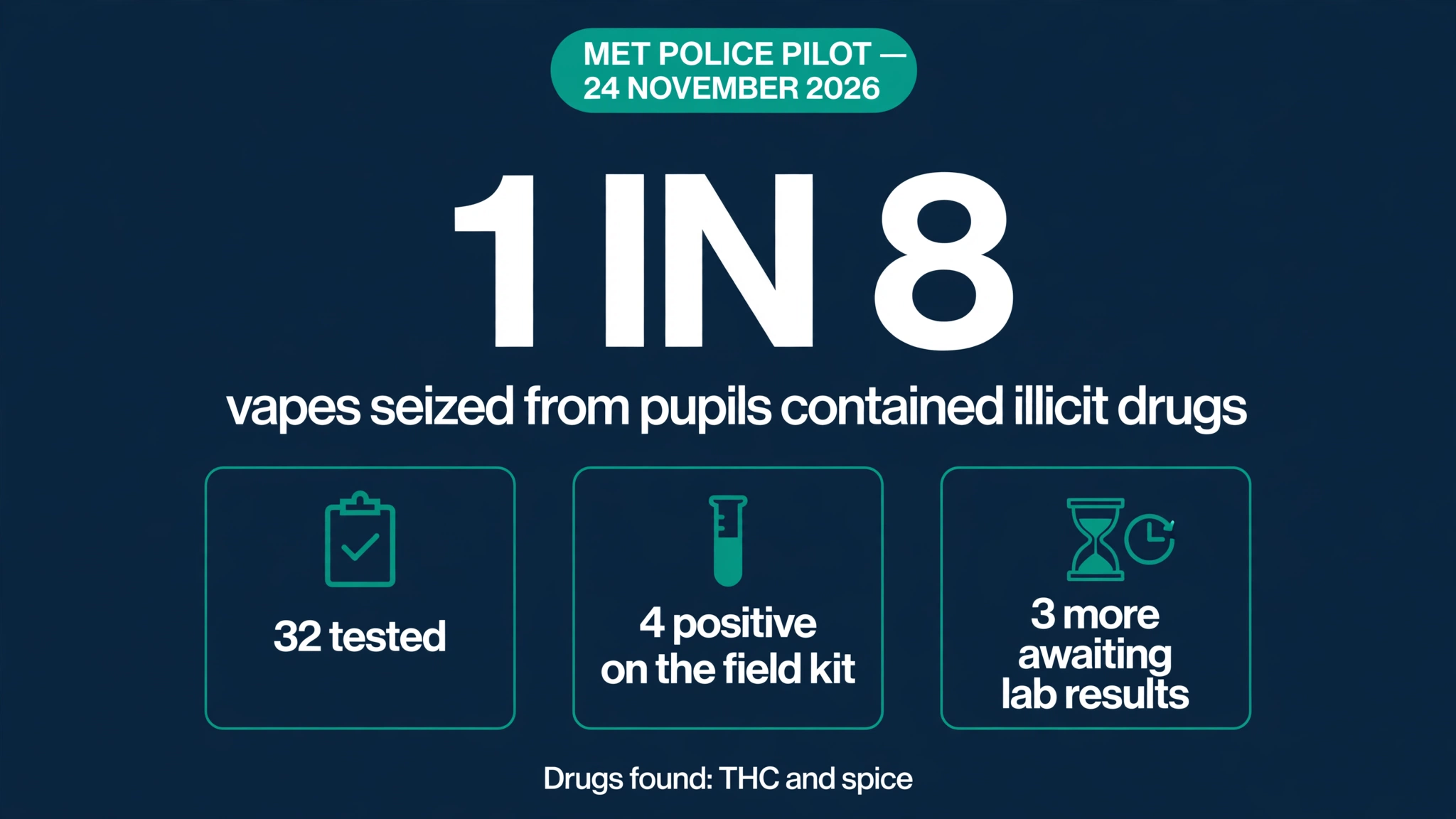
A Metropolitan Police pilot published on 24 November 2026 found drug-laced school vapes: one in eight vapes confiscated from pupils in south-west London schools contained illicit drugs. The force calls it the first scheme of its kind in the UK.
Key facts
| Published | 24 November 2026 |
| Who ran it | Metropolitan Police, with schools in south-west London |
| Vapes tested | 32, seized from pupils |
| Found with drugs | Roughly 1 in 8 (4 of 32 confirmed, 3 more awaiting lab results) |
| Drugs found | THC and spice |
| First of its kind | The Met says it is the first scheme of its kind in the UK |
Drug-laced school vapes: what the pilot found
Officers used a portable detection device to screen 32 vapes seized from pupils. The machine extracts vapour from a device and returns a result within minutes. Roughly one in eight contained illicit substances, including THC, the psychoactive compound in cannabis, and spice, a group of synthetic cannabinoids.
Four of the 32 devices tested positive on the field kit, with three more expected to be confirmed by laboratory analysis. The Met has not said when those lab results will be complete, so the final proportion is not yet fixed. The officer leading the work called the early results “surprisingly high”.
A small sample
Thirty-two vapes is not a nationally representative sample, and nobody should read “one in eight” as a UK-wide rate. Pupils hand over only the devices they are caught with, and schools differ in how they search. The result is a snapshot of one set of schools.
Earlier work points the same way: research from the University of Bath found up to a quarter of vapes confiscated from secondary schools in England contained spice.
Youth vaping overall has levelled off, with around 6% of 11 to 17 year olds currently vaping.
Why children are at risk
Deputy Assistant Commissioner Ben Russell said children had become unwell after using a vape “thinking it was just going to give them some nicotine and a nice smell” and then consuming something they did not expect. The pilot followed reports of pupils becoming seriously ill after using shared devices or products they believed were ordinary nicotine vapes, not drug-laced school vapes.
The Met said pupils were buying vapes through social media, friends, older siblings and in the playground. “That really does put you at risk because you simply don’t know what you’re putting in your body,” Mr Russell said.
The Kingston college case
In April 2026, officers were called to a college in Kingston after a 17-year-old student lost consciousness following the alleged use of a vape believed to have been laced with drugs. A later search seized cannabis, a vape device and a bottle of pink liquid labelled “PEACHSILK, 5000MG THC”. Forensic analysis confirmed that two vaping products contained THC, a Class B controlled drug.
The Met said it had received about 200 reports linked to spiking involving children over the past year, covering every form of spiking, not just vapes. Positive outcomes, including arrests and charges, had risen by 36%.
Police target suppliers, not pupils
The force said it was not seeking to criminalise children for using vapes, but to go after the people who supply drug-laced school vapes. Schools have long worried that heavy-handed responses would stop pupils speaking up when a friend becomes ill.
Mr Russell urged anyone who believed they had been spiked to contact police as quickly as possible. The first 12 to 24 hours are crucial for evidence. For parents, that means acting fast if a child collapses, vomits repeatedly, becomes unusually drowsy or confused after vaping.
What parents and teachers can do
- Talk early. Explain that a vape bought online, passed around or sold in a playground may not contain what the label claims.
- Know the warning signs. Sudden dizziness, vomiting, fainting, heart racing, confusion or unusual behaviour after vaping all warrant urgent medical help.
- Keep the device. Hand a confiscated vape to police or the school rather than throwing it away, so forensic testing can confirm what it contained.
- Report quickly. Contact police within hours, not days, if spiking is suspected.
- Look at supply. Ask where a child obtained the product; social media sellers and older peers are the routes named by the Met.
What happens next
The Met has not said whether the pilot will be extended, or when the lab results will be published. Until then, the advice is straightforward: assume a vape of unknown origin could be one of the drug-laced school vapes, talk to children about the risk, and report suspected spiking without delay.
The rules on selling to under-18s have also tightened: from 29 October 2026 the ban covers every vape, including nicotine-free ones.
FAQ
How many vapes had drugs in them?
Four of the 32 devices tested positive on the field kit, with three more expected to be confirmed by laboratory analysis. That is roughly one in eight.
Does this mean one in eight vapes everywhere has drugs?
No. The pilot found drug-laced school vapes in one set of schools. Thirty-two vapes is a small sample, not a UK-wide rate.
What should a parent do if a child is ill after vaping?
Seek urgent medical help, and contact police as quickly as possible. The first 12 to 24 hours are crucial for evidence.
Will children be punished for using vapes?
The Met says it is not seeking to criminalise children. It is targeting the people who supply dangerous products.
Read more UK vape news on our All News page.
Source: https://manchestertimes.co.uk/2026/11/24/drug-laced-school-vapes-met-pilot/